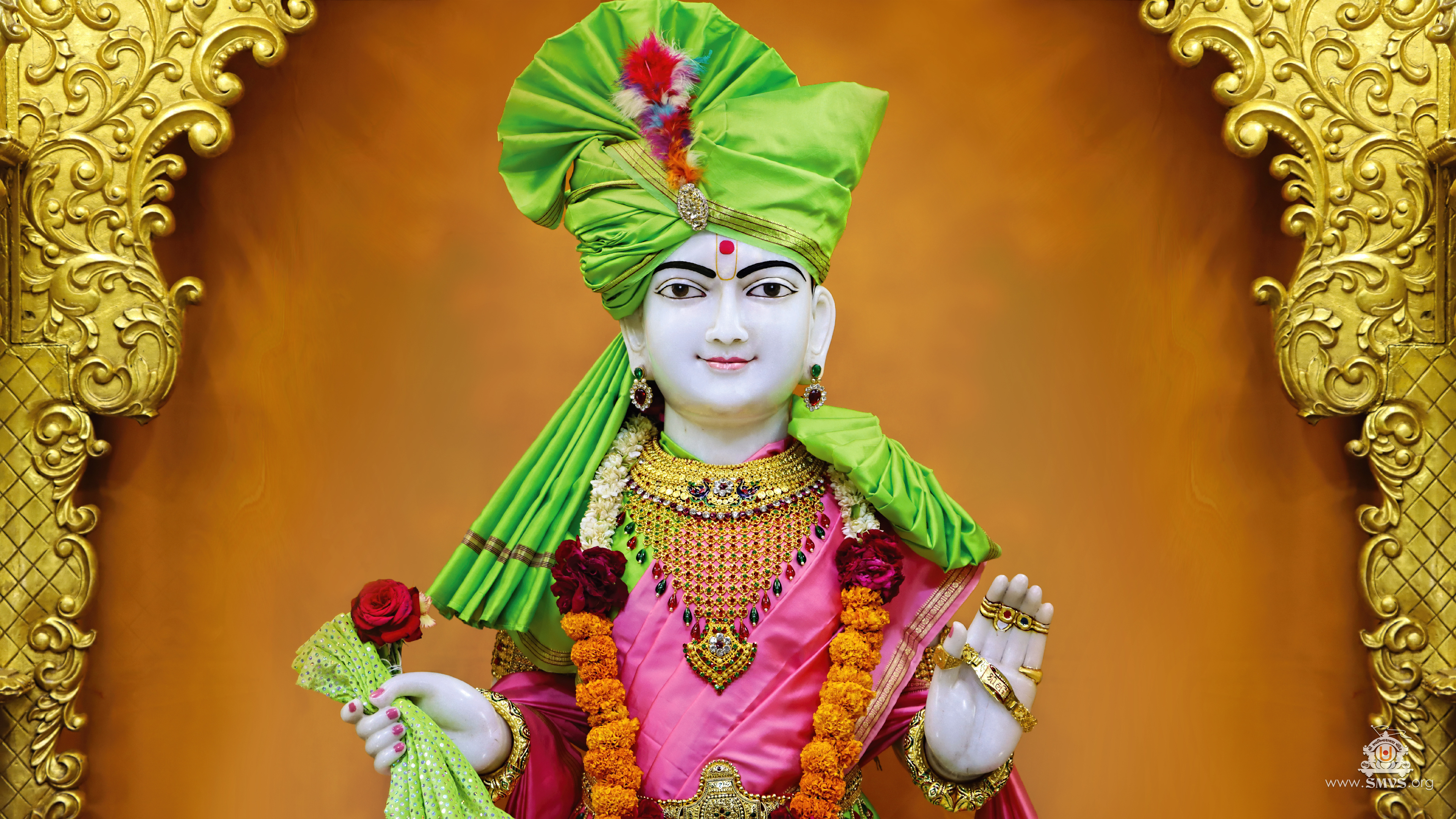



Shikshapatri Mahima
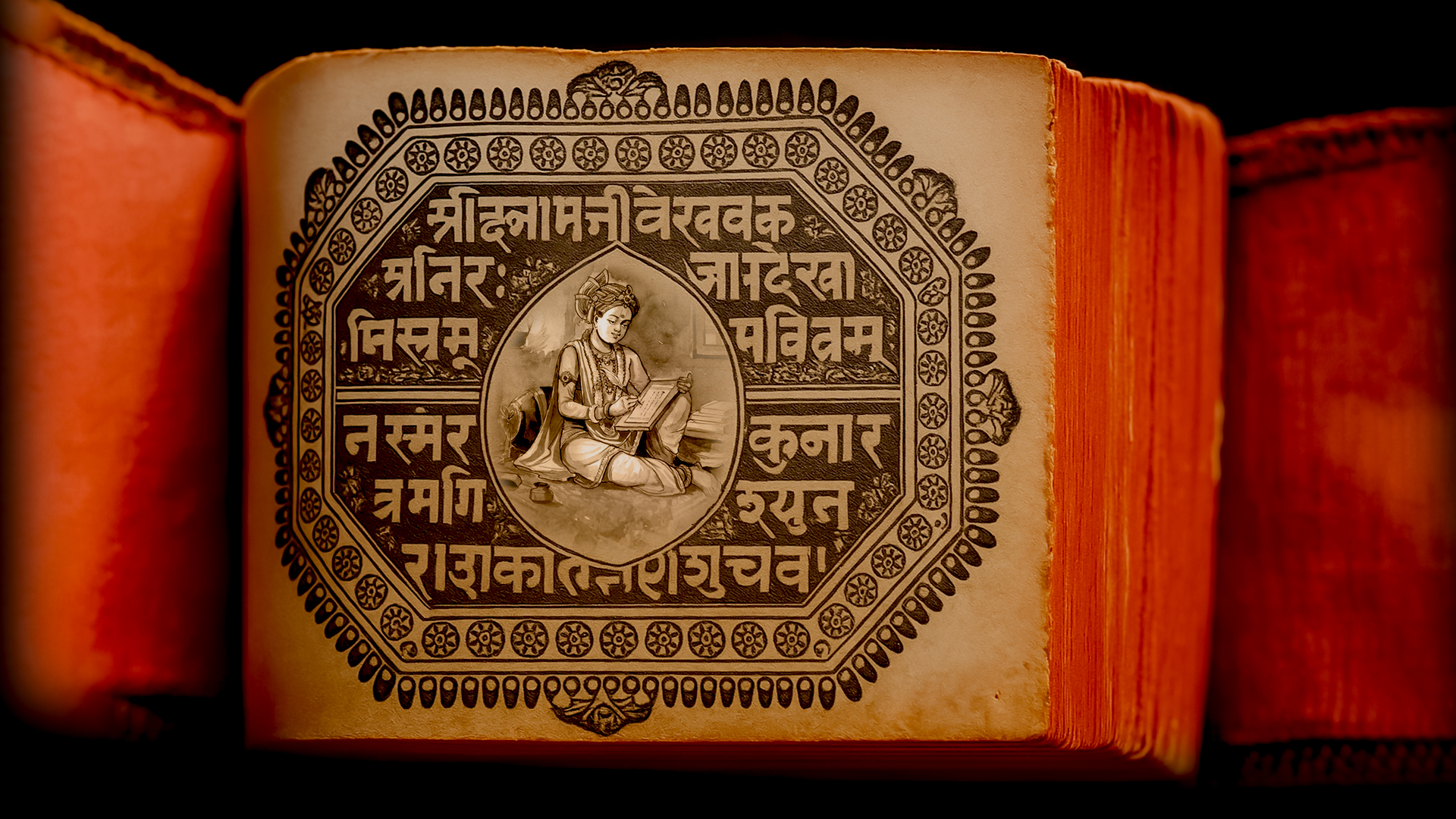
- “Just as a shooting star appears in the sky, followed by a streak of lightning, which is even more radiant, is nothing but God’s Signature.”- reading a phrase evokes a sense of positivity, but it remains a work of fiction rather than reality.
- "If something is found bearing the God's writing, would it undoubtedly be the Shikshapatri!"
- The Shikshapatri, written on the day of Maha Sud Pancham (Vasant Panchami) in the year 1882, is the creation of Bhagwan Swaminarayan Himself. "Likhāmī Sahajānand Swāmī" (Shikshapatri Verse 2).
- Bhagwan Swaminarayan’s handwritten and oral teachings have given rise to two significant scriptures in sequential order: the Shikshapatri and the Vachanamrut. The Shikshapatri, as compared to Vachanamrut, isn't confined to just the community; it is framed to benefit all living beings, promoting their welfare. Moreover, it encompasses the entirety of human existence – mind, body, and soul. It underscores the significance of spiritual principles and ethical conduct. At times, when Shikshapatri integrates in one’s life humans remain segregated from animals based on dharma and religious practices. The Shikshapatri is a remarkable guiding document that not only enriches worldly knowledge but also propels spiritual understanding to unprecedented heights. Let’s Dive into this remarkable epistle and explore its insights today.
- Authored 2 century ago, the Shikshapatri is a remarkable religious text. In this composition, He has penned his distinct writing that sets forth a transformative path. The followers who embrace these teachings, irrespective of their societal or vocational domains, find their stature elevated, leading to prosperity, joy, and honor. This sacred text has secured a revered place in the hearts of countless individuals and communities, adorning them with dignity and reverence.
- Indeed, people often say that those who follow the Swaminarayan faith are blessed with happiness. One individual even remarked that only the "rich" people adhere to the Swaminarayan faith. However, this notion is not entirely accurate. In reality, those who practice the Swaminarayan faith become spiritually, socially enriched and prosperous. Their true rewards lie in following the teachings of Shikshapatri, where Swaminarayan's divine commandments are expounded.
- Indeed, upon studying religious scriptures carefully, it becomes evident that the rules mentioned therein are contextual and adaptable to the time, place, and cultural circumstances. These rules are designed to be relevant during specific periods and under specific conditions. Consequently, once appropriate may become inappropriate due to changing circumstances.
- Absolutely, the teachings and principles outlined in the Shikshapatri, written in the 18th century, were indeed well-suited and commendable for the context of that time. Surprisingly, even in the 21st century, the Shikshapatri remains more adaptable, relevant, and praiseworthy. This is why it has been referred to as a timeless scripture. The Shikshapatri has never become out of date. It continues to provide guidance and wisdom that is applicable across generations, making it a remarkable and enduring source of spiritual and ethical teachings.
- The Shikshapatri- A code-of-conduct of Swaminarayan sampraday (faith). It encompasses the aspects of Dharma (righteousness), Artha (material prosperity), Kama (desires), and Moksha (spiritual liberation). Shriji Maharaj has mentioned his followers as Acharyas, Brahmacharis, Sadhus, devotees of God, Suvasinis (married women), and Vidhavas (widows) in this scripture (Shikshapatri verses 3, 4, 5). He advises them all too carefully and lovingly adhere to these teachings. The Shikshapatri, which serves as a manual for mankind, directs how should one utilize this unique opportunity of a human birth? How can one lead a life that does not fall into the trap of transmigration? How should one navigate through the challenges of life?
- The Shikshapatri is the manual card for human life. It provides guidance on how to live life joyfully and contentedly in the realm of worldly existence.
- The Shikshapatri is a letter of guidance, providing instructions on do’s and don’ts. Just as we follow physical laws, drive vehicles according to traffic rules, in school or in a company we also adhere to certain regulations and obligations. Sometimes, we might need to endure consequences or penalties for breaking those rules. In the same way, the Shikshapatri contains rules set by Bhagwan Swaminarayan. It presents detailed regulations for every aspect of life. Acharyas, brahmacharis, sadhus, devotees, married women, and widows all have specific guidelines outlined for them. Following these guidelines, is emphasized as essential.
"Our beloved disciples should embrace this Shikshapatri with love and tread its path diligently. Remember, its commands are not to be crossed.”
- Verse 10, Shikshapatri
- Breaking rules results in punishment. Similarly, in spiritual journey, God punish to mind, body and soul which results in disturbances.
- In the Shikshapatri, both general and specific codes of conduct are outlined. It describes the daily practices of the virtuous, including the rules for Acharyas, their spouses, householders, kings, chaste widows, Brahmacharis, and Sadhus. These guidelines are meant to be perpetually followed, emphasizing the importance of regularly reading.
"The Shikshapatri that we have written instructs our devoted sadhus, Brahmacharis, and householders to daily read and recite its teachings. Those who find it difficult to recite should listen to it daily, and those who are unable to listen should worship the Shikshapatri daily. This is why we have written in the Shikshapatri. Therefore, as per these, those who miss should observe a fast. This is our command. Everyone has adhered to this sayings prescribed by Shriji Maharaj. Upon hearing this, Shriji Maharaj became exceedingly pleased and blessed all the sadhus and Brahmacharis with divine joy.”
- Gadhada last 1, Vachanamrut
- In the Shikshapatri, rules for every category have been delineated, and it is directed that each group should read it daily. Indeed, those rules that apply to a particular group or are relevant to one’s ashram, should read by such group. But why one should read other rules? With a viewpoint of alertness, if all are aware of everyone’s rights and duties every group can watch and judge each other’s ethical livings. In result, it develops awareness, purity and transparency to follow the codes. Thus, the Shikshapatri can be likened to an "Open Book". So, Shriji Maharaj publicly presented to show and care the purity of sect for eons.
- The verses of the Shikshapatri hold dual meanings – each verse encapsulates both implied and explicit messages. Merely reading the verse, one cannot extract the fruit, but bewilder in bushes. It is only when you comprehend its inherent tenets, then only you can truly please Shriji Maharaj. Thus, rather than following words of Shikshapatri, follow by focusing on its depth.
- According to the Shikshapatri, there are verses that provide guidance on both general and specific aspects, they are,
- Common Commands 11 to 121
- Specific Commands for (as per ashrams/categories)
- Acharya 123 to 132
- Acharya’s Spouse 133 to 134
- Devotees 135 to 154
- Richest one 155 to 156
- King(or similar posts) 157 to 158
- Married Women 159 to 162
- Widow 163 to 172
- Married-Widowed (for both) 173 to 174
- Ascetic 175 to 187
- Sadhu 188 to 196
- Ascetic-Sadhu (for both) 197 to 202
- The Shikshapatri is the embodiment of Shriji Maharaj’s divine teaching. It imparts guidance rather than punishment. While some scriptures may detail consequences for not adhering to their instructions can lead to the ‘Kumbhipaka’ or ‘Raurava’ hell, it causes point of fear. While, Shikshapatri seeks to reassure and uplift individuals, fostering a sense of spiritual growth and understanding. Shriji Maharaj, in the manner of an astute doctor who, with affection, sweetly administers bitter medicine or injections to a patient in order to cure them, similarly imparts teachings to his devotees without causing them unnecessary difficulty. He extends his true help and guidance politely, emphasizing the importance of virtuous behavior. Thus Shikshapatri is a letter of direction to their beloved with utmost affection, not a letter of reprimand.
- Through the Shikshapatri, Shriji Maharaj has bestowed priceless guidance on the holistic development of life and the relationship between this world and the hereafter.
- The Shikshapatri is a kind of conduct. Through it, social, economic, and spiritual upliftment is achieved, and for eons, the foundation of religion will become stronger and stronger through it.
- The actual interpretation of dharma and Shriji Maharaj's perspective on dharma can be understood as follows in the verse:
- In the Swaminarayan Sampraday, there are two aspects: "Agnya" (Commandments) and "Upasana" (Worship). "Agnya" signifies rules and righteousness, while "Upasana" signifies devotion and faith. Without the firmness of both these aspects, the society of devotees, the sants, lacking in such principles becomes fragmented and empty.
- The Swaminarayan sect is renowned for its spiritual principles, not just mere words. During the time of Shriji Maharaj, there were 3000 outstanding sadhus who were exemplary for their conduct. Their practical teachings facilitated transformative changes and led to spiritual growth.
- HDH Swamishri often says, 'It is not the command that holds significance, but the one who command is significant.'
-
The benefits of adhering to the rules are as below:
(1) Trust
By following religious rules in practical and spiritual paths, and this builds trust among devotees and the public. In the past, exemplary figures like Kashiram Bhai Professor from Lunavada and Shivalal Seth from Botad played such commendable roles.
(2) Sharpness of the senses:
When we follow the rules and dedicate ourselves to God regardless of being householders or ascetic, it becomes easier to manage and control our senses. By avoiding distractions and keeping our senses in check, we achieve a sense of inner purity. This purity not only helps in controlling external senses but also aids in remembering God effortlessly.
(3) Conquering the five senses:
In the 16th Vachanamrut of Gadhada Middle, it is mentioned that, it is explained that even if we may not be full renunciants, following the rules and controlling our senses as if we were, allows us to conquer temptations. By sticking to these rules, we gain mastery over our desires and live in harmony with the guidelines set by God.
(4) Attaining God's Bliss:
When an individual neglects the directives of God and starts to deviate from them, they undergo hardships. Conversely, if one behaves in accordance with those directives, they will encounter the genuine joy of God.
Gadhada First 34th Vachanamrut
Staying in the command of Shri Hari (God) results in its fruit being extremely sweet, this fact is mentioned by Shri Hari Himself in the 'Vachanamrut' scripture and by the Jivanpran Bapashri, in their sermons.
"When one follows God's command, God becomes pleased with them."
Gadhada First 25th Vachanamrut
“If we strictly adhere to the panch vartman and do not allow any sort of lapse in their observance, God and His Sant will be pleased. There is not even the slightest doubt about this.”
Gadhada First 78th Vachanamrut
A person whose nature is such that he is diligent in obeying the commands of God, and who would never disobey any command, however minor or major, will never decline from dharma, irrespective of the circumstances. Therefore, only his dharma remains firm who is resolute in obeying God’s injunctions, and only his satsang remains firm.”
"The one who serve (seva) but does not follow the injunctions is futile. Because he does not have a connection with the Supreme Lord, thus his service does not reach Shreeji Maharaj. However, if one serves those who adhere to the injunctions, Maharaj accepts that service while residing within them."
Sermons of Bapashri : 1/74
“Just as one who knows the glory of a king obeys his commands, similarly, one who knows the glory of Maharaj and Satpurush obeys their commands and get rids of sins."
Sermons of Bapashri : 1/152
Excellence of the Shikshapatri
"Currently society is devoid by values, it became necessary to impart common sense to who blindly followed unworthy customs, distinguishing where to split and where not. Swaminarayan Bhagwan provided guidance through the Shikshapatri scripture. To rescue humanity from the filth of violence, theft, falsehood, adultery, and deceit, this scripture was bestowed upon them. It aimed to firmly establish the duty of one's own righteousness in life, crafting such a clear path of righteous conduct that one would never stumble behind rules. Even a wavering individual could ascend spiritual peaks by adhering to it."
-Ishwar Petlikar
"Shikshapatri serves the purpose of purifying the harsh and tumultuous life, the society, and the inner being by seeking the purest amidst impurities. Shikshapatri means a perpetual code of conduct for purifying behavior and society."
-Poet Nhanalal
"When the people of the country adhere to the commandments of the Shikshapatri, there is a lesser need for stringent laws, police, and courts in the nation."
-Sardar Vallabhbhai Patel
And for this reason, Shri Hari has composed the Shikshapatri in such a beautiful manner that it includes the essence of 511 IPC codes (Indian Penal Code) within its 212 shlokas. A person who adheres to the Shikshapatri should not be summoned to the court as an offender.
IPC Code No.
Shlok No.
Types of Offence
107 to 120
27
Define act of abetment.
121 to 140
34
Offenses Against the State Activities.
141 to 160
201
Covers law for Unlawful activities, riots and similar disturbance in public order.
161 to 171(I)
26
Bribery, and Corruption.
172 to 263(A)
34
Offenses against public tranquillity, public servants, false evidence, and against the state.
264 to 267
152
Providing false evidence, intentionally giving false information to a public.
268 to 278
32
Endanger public health or safety, or create inconveniences for the public/public places.
279 to 294(A)
36
Rash and Negligent Acts- negligence or recklessness that lead to harm or endangerment to human life, property, or public safety.
295 to 298
84,21,23,25,29
Damaging, defiling, or disrespecting places of worship, religious objects, or any place held sacred by a religious community.
299 to 304 A
11, 13
Unlawful killing (Murder) and their respective punishments.
305 to 311
14
Abetment of suicide, kidnapping, and abduction
312 to 318
11, 13
Causing miscarriage, injuries to an unborn child, and related matters.
319 to 358
11, 13
causing harm, violence, or distress to others
359 to 377
18
Kidnapping, abduction, and certain offenses against decency and morality
378 to 404
17
theft, robbery, extortion, and criminal misappropriation
405 to 409
37
Criminal misappropriation and criminal breach of trust.
410 to 414
17
dishonestly receiving stolen property
415 to 424
37
Cheating by breaching the trust
425 to 440
75
Damaging, disturbing and harassing the living beings by his own mischief
3441 to 462
33
Act of trespassing onto another person's property or land.
463 to 489D
143, 146
Forgery, counterfeiting, and other related crimes.
490 to 492
139
Care and maintenance of elderly parents and senior citizens in India. under Maintenance and Welfare of Parents and Senior Citizens Act, 2007
493 to 498
18
"Marriage" and "Cohabitation caused by a man deceitfully inducing a belief of lawful marriage."
499 to 509
20
Defamation, criminal intimidation, insult, and other related matters.
510
15
The act of publicly consuming alcohol and causing a disturbance
511
17
Where someone tries to commit an offense, but for some reason, the offense is not completed or keeps a relation with offender.
Yes, the Shikshapatri is small, but it contains the whole ocean within it. It is thus said, 'The Shikshapatri is like the ocean in a pot.'
"For those who aspire to firm adhere supreme theology and commandments, Shreeji Maharaj has provided the foundation of rules in the Shikshapatri.
"The Shikshapatri is like a stair containing the essence of all scriptures. Its upper part focuses on the highest spiritual attainment. Meanwhile, its lower part addresses the role of common human life. Between these two aspects, it beautifully balances lofty ideals with practical behavior, thus establishing simple yet firm footsteps towards the ultimate goal."
-Tribhuvan Vyas
Facts
- The Shikshapatri was initiated to be written on the 12th of February, 1826, at Vadatal, at 11:00 in the morning.
- In 1823, the Shikshapatri consisted of 149 shlokas, which increased to 212 shlokas in 1826.
- It was composed in the Sanskrit language, and Sadguru Nityanand Swami translated it into Gujarati, while Shatanand Muni included it in the 4th chapter of ‘Satsangi Jivan’.
- To distribute it to his followers, the Shikshapatri initially comprised in the eight copies. One was gifted to Sir Malcolm at Rajkot on 26th February 1830. The first verse demonstrates as a start of satsang, the 108th verse as you are at mid of satsang, and the 209th verse as end of satsang.
- The Shikshapatri is the verbal form of Shreeji Maharaj.
- Within its 212 shlokas, it includes the essence of the Indian Penal Code's 511 sections. If a person follows the Shikshapatri, they do not violate any section of the Indian Penal Code.
- The Shikshapatri comprises 642 sentences, emphasizing both positive rights and negative prohibitions.
- The author of the Shikshapatri is referred to as Sahajanand Swami. Although the name Swaminarayan does not appear throughout the Shikshapatri, the name of his eternal form, Anadishri Krishna, is mentioned 36 times.
- The Shikshapatri is unaffected by the constraints of time. It is not outdated.
- The Shikshapatri is the only book written directly by the supreme Lord himself.
- It is taught as a textbook at Banaras Hindi University.
- Translations of the Shikshapatri are available in 10 languages of India, including Bengali, Gujarati, Hindi, Marathi, Sanskrit, Tamil, Telugu, Odia, Urdu, and Vraj. Additionally, there are 19 foreign language translations, including African, Arabic, Chinese, Dutch, English, Finnish, French, German, Italian, Hebrew, North Sotho, Portuguese, Russian, Spanish, South Sotho, Swahili, Xhosa, and Zulu.
- Sadguru Gopalanand Swami wrote the Shikshapatri in Marathi.
- Sadguru Muktanand Swami wrote it in Hindi prose and poetry.
- Sadguru Nishkulanand Swami wrote it in poetry couplets.
- Sadguru Brahmanand Swami wrote it in Chhand Shlokas.
- Sadguru Premanand Swami wrote it in poetry and Avadhi language.
- Shreeji Maharaj presented the Shikshapatri to Sir John Malcolm during their meeting. It is preserved in the Bodleian Library. Its size is 5" x 3", comprising 166 pages, with Sanskrit verses on each page and five pages left blank.
- Other books related to the Shikshapatri include ‘Shikshapatri Bhashya’ by Shatanand Muni, ‘Shikshapatri Rahasyarth’, which elaborates on the direct and indirect meanings of each verse by Muni swami, and other books such as Shikshapatri Arth Deepika, Shikshapatri Rahasya, Shikshapatri Vivechan, and Shikshapatri Bhashya Vivechan.
- The Shikshapatri is a unique scripture, representing the desire for a happy life in this world and in parbhav.
- It is the code of conduct of the Swaminarayan tradition.
- In the Shikshapatri, rules are prescribed for each category of individuals, and daily reading is recommended for all. The categories include the acharya (spiritual leader), acharya's wife, householders, rich devotees , kings, women, widows, celibates, ascetics, and others. From verse 123 to 202, a total of 80 verses out of 212 contain these rules.
- Following these rules is not very difficult, but it is not impossible either. If one neglects the commandments, it may incur the wrath of the Lord, so it is essential to adhere to them.
- If, by mistake, any of the commandments are violated, the appropriate penance is also prescribed. It is advisable to ask knowledgeable elders for guidance because procrastination afterward leads to laziness. Without penance, one cannot attain spiritual devotion, and without it, progress is hindered.
- The "Shikshapatri" was written 188 years ago when society was completely new. Therefore, at that time, the Shikshapatri was mostly written indirectly. In scriptures, mainly four types of things are mentioned: interesting, differentiating, frightening, and real. So, the Shikshapatri contains instructions as needed by the society then. However, over the years, society has been purified through saints' sermons. So, the instructions given by satpurush are followed in the society. For this purpose, revered HDH Bapji gave us the essence of the Shikshapatri. In which, the original Shikshapatri’s hidden and implicit purpose are deciphered.
- Along with this, for an ideal behavour for satsangi as per the Swaminarayan tradition, other instructions such as guidance on daily worship rituals, observance of purity during menstruation and childbirth, details of the required observances during eclipses and in daily life, daily prayers for pleasing the Bhagwan Swaminarayan, practicing ideal Mansi pooja. and rituals of Maha Pooja. have been included.
- In the current situation, reading books for students is a challenging circumstance. Because even in books, there is often profound content that can be difficult for students to understand. Therefore, the publication of guidebook has become necessar. Similarly, in the spiritual path as well. Without the guidance of a Satpurush who can decipher many profound and subtle teachings? Therefore, the composition of the 'Shikshapatri Sar' is considered equivalent to the expected alternative, making it easier to understand.
- Yes, in 'Shikshapatri Sar,' Shriji Maharaj's instructions and preferences are clearly explained, thereby enabling the guardian to have more simplicity, accessibility, and clarity, as well as increasing faith in adhering to the rules with understanding.
"Dharm Dharm To Sāhu Kahē, Pan Dharmmā Ghano Marm Chhe;
Pra-gaṭ Prabhu-nā Vachan Māno, Ē Ja Kharo Dharm Chhe."
Why Shikshapatri is unique?
What is essence of Shikshapatri?